Opinion: AI as a Creator? AI and its Place at a Christian College
You have heard about AI, and everyone is talking about it. In fact, you have probably heard so much about it that you are about ready to just stop talking about it altogether, thinking, “Really, what is the big fuss all about?” Well, let me throw one more argument into the ring relating to your Christian college education - that thing you are paying over $25,000 dollars a year for with those professors you know and love.
Should AI be used in your classrooms? At the forefront, it could be argued that it is beneficial in helping you understand skills for your future careers, which in part, is what college is for.
For example, imagine you are an English Education major: you could learn how to leverage AI and make a worksheet tailored to the novel you are reading in your ninth grade classroom. It can even adapt the document to the specific academic standards you are looking at. Maybe it can even grade papers for you. It sounds really helpful.
However, if AI can do it for you, why did your professors teach you the nitty gritty details of how to formulate a worksheet or give strong feedback to students and their writing (their voice matters, too)?
This does not only apply to education. This stretches across all disciplines, STEM and the humanities alike. For instance, there are tools being developed for academic research that will do everything your librarian and your library’s system could do, but it’s AI doing it all for you.
Take the AI platform Consensus as an example of this new wave. While Consensus is not the same type of open-ended chatbot like ChatGPT, it is still stripping away valuable research skills (like learning how to consult a librarian!) away. If you are going to utilize AI to generate something, like a creative writing paper, why did you pursue a college degree where professors teach you how to create? God made humanity in his image and granted them the ability to form ideas, build, and create. Do not outsource such a gift to a machine.
As AI develops, it gets harder to spot by professors or student workers. The fact of the matter is, on a base level for most disciplines, as Nicolas Tampio remarks in “Should AI be permitted in college classrooms? 4 scholars weigh in”:
“Students could get fine grades if they used ChatGPT to ‘write’ their papers.”
Though, in doing so, it is stated in an article from Duke’s Center for Teaching and Learning that,
“In the higher education context, researchers have found that university students who use Large Language Models (LLMs) to complete writing and research tasks experienced reduced cognitive load but demonstrated poorer reasoning and argumentation skills compared to those students using traditional search methods.”
The utilization of AI in coursework is slowly taking away the critical thinking faculties of an individual. Research conducted by College Board shows that 84% of professors are in agreement that AI reduces a student’s critical thinking, originality, and deep engagement with the material that they are being taught. Your professors are here to teach you how to think well. At Lee University, you are being prepared for Christian living in a complex world, which fundamentally requires you to develop your critical thinking.
You may be thinking, “It can’t be that bad - what if I use it like a search engine and just ask simple questions?” In theory, this seems to be a good idea, using it no different than you would use traditional Google (without Gemini). Maybe at first it begins with you asking normal, everyday questions, but it is quickly able to snowball into much more than that.
Beth Stackpole in her article speaks to Eric So who highlights that there are three factors that feed into overreliance on AI, such as when AI is able to do a task, it falls in line with human instinct to conserve the mental energy and allow for it to do the task instead. Additionally, there is significant societal pressure to get a “leg up” and as AI becomes more difficult to detect, the benefit of enhanced productivity becomes all the more enticing.
There is a call for integrity for situations such as these, academic and otherwise. Integrity as a Christian refers to being honest, sincere, and upright. If you allow AI to take the place as a creator within your life, integrity begins to slowly slip away as you pass its creation off as your own.
It may start as a menial thing, but as you desire to conserve more energy, you begin to rely on the system more and more until you have dug yourself into a pit you cannot get out of. You allow it to create for you instead of taking on the daunting, yet wonderful, task of creating yourself. So, it may just be best to never start utilizing it in the first place or stop using it while you are still ahead.
This is not to say you can entirely avoid AI. AI will inevitably be present within your workplace, and there is practically no escape from it right now in the world. However, just because it is present near you does not mean you have to allow it the opportunity to create when that is a responsibility and honor bestowed onto you.
As Samuel James illuminates in his article, “How Is AI Shaping You? Three Principles for Wise Use,” when you allow this technology to take on the human capacity to create, you open the door for it to become an idol within your life.
In order to serve your workplace and your community, in or outside of Lee University, wholeheartedly and with faith, you ought to move away from AI that seeks to take away those such qualities that God designed. Seek to be the change and be set apart in the world around you.
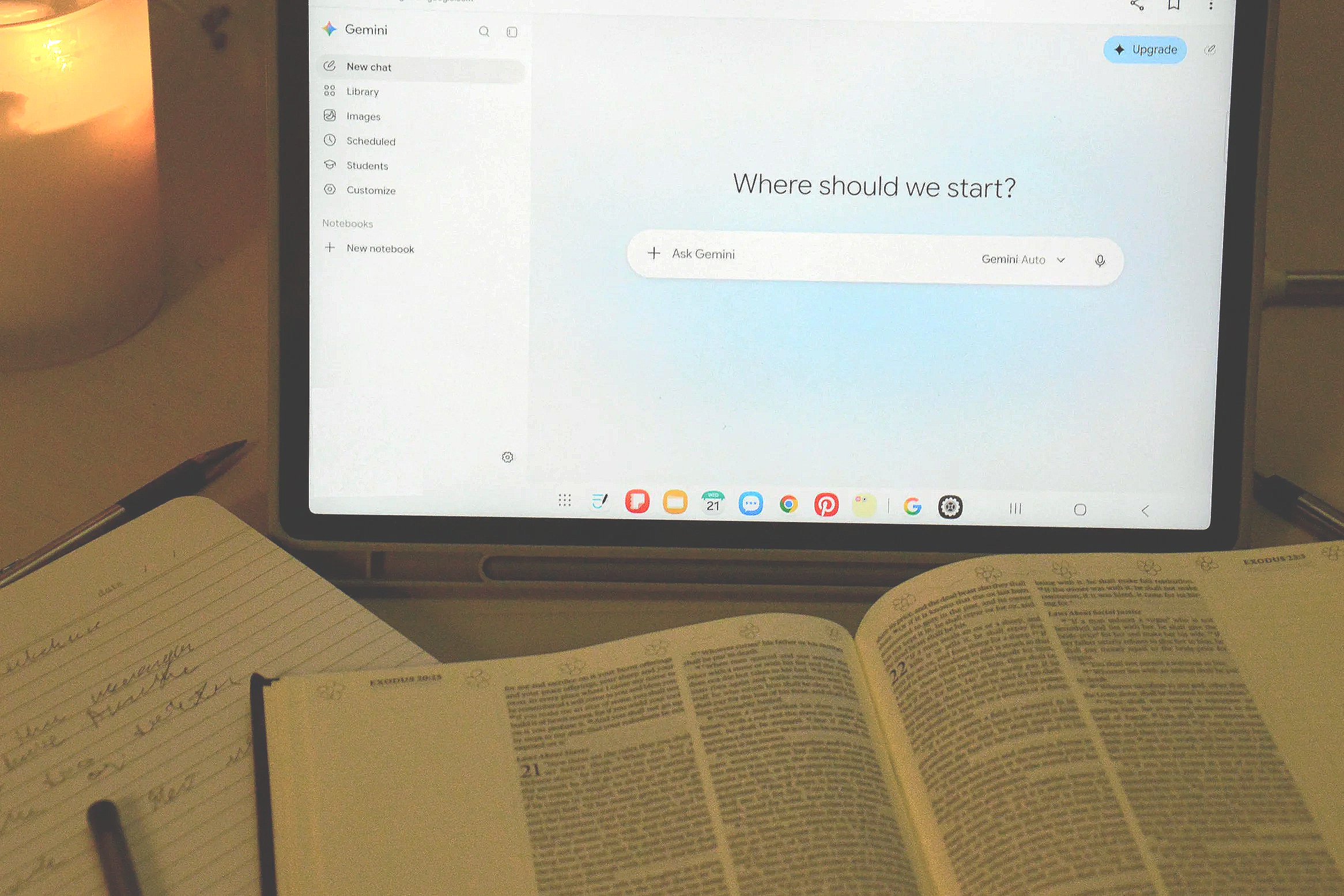
Photo by Emme Lowder.
Thank you, Jessica, for your submission to the Clarion.